


The Unspoken Rules Of Office Holiday Party Outfits

Read The Room Before You Dress
You care about this because wearing the wrong thing signals you don’t belong, and that fear cuts deeper than most admit. The mechanism is simple: office culture operates like a closed ecosystem. Dress codes aren’t written to be enforced, they’re written to separate who understands the system from who doesn’t. Your outfit either confirms membership or broadcasts outsider status. Most people misread their company’s actual dress expectations because they listen to HR policy instead of observing what power actually wears.
The gap between stated dress code and lived dress code explains most outfit failures. A company claims business casual, but everyone in leadership wears tailored pieces with visible fabric structure. Another says cocktail attire, but half the room shows up in dark jeans. Walk through the office before the party. Note what senior women wore last week. That’s your real dress code. The policy document exists for legal protection, not guidance.
Stop Following Generic Party Dress Advice
Everyone says the same thing: add a blazer, keep it classic, don’t overshadow leadership. This is incomplete guidance that leaves you guessing. The real mistake isn’t looking too formal or too casual, it’s looking like you tried harder than your role demands. Overdressing signals either desperation to impress or misunderstanding of your rank. Underdressing reads as disrespect for the event itself. The target isn’t perfection, it’s calibration.
The protocol is mechanical: choose one statement piece, then subtract everywhere else. If you wear a textured fabric with visual weight, pair it with simple basics. If you choose bold color, keep silhouette neutral. If you add jewelry, eliminate print. Never layer visual interest. This isn’t about rules, it’s about signal clarity. Your outfit should communicate competence, not create noise that pulls attention. Start with what you own that requires zero adjustment, then add one deliberate choice.
The “Strategic Silhouette” Protocol For Christmas Cocktail Dresses
What Your Dress Actually Communicates
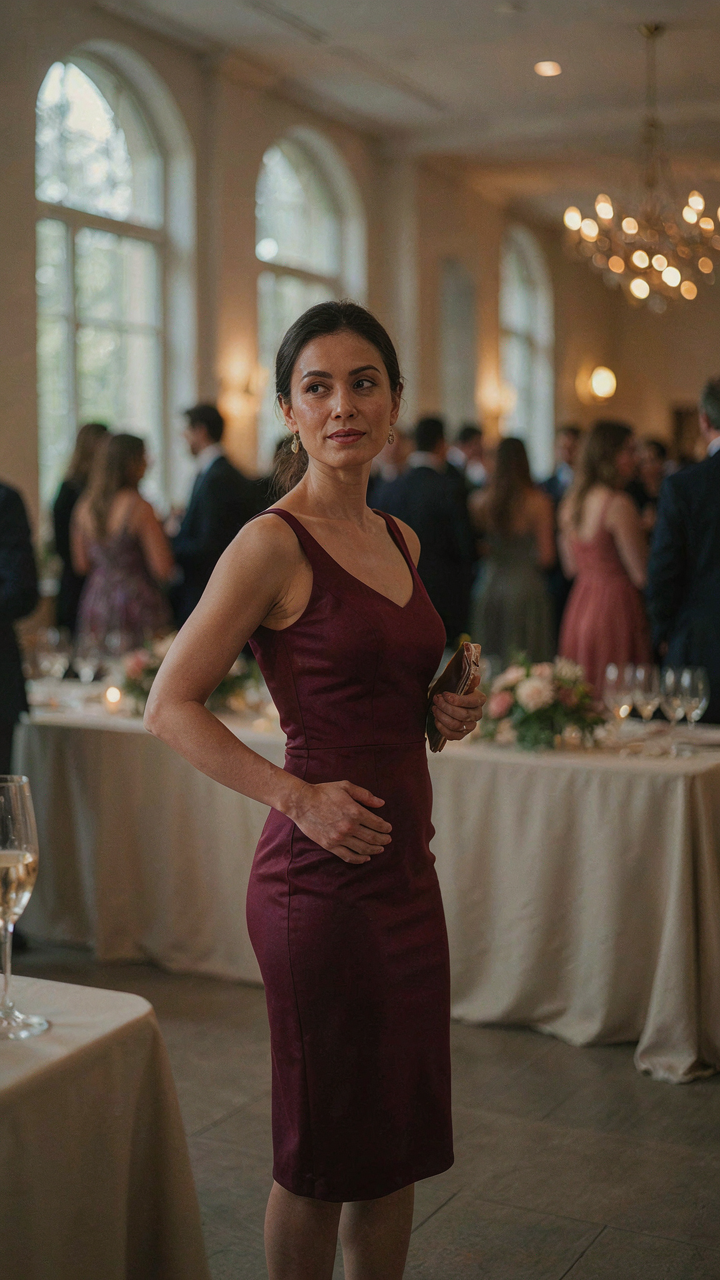
You care about this because you’re afraid people will read you wrong in the room. Here’s what actually happens: clothing is applied proxemics. It controls how close people stand to you and whether they initiate conversation. A fitted silhouette with defined waist creates vertical containment. People perceive containment as control. A loose or shapeless cut reads as defensive posture. Your nervous system responds to how others position themselves around you, which then determines what opportunities surface during the event.

The dress code at corporate events isn’t about looking nice. It’s about signaling you’ve calculated the room’s expectations and met them deliberately. Silhouette matters more than color or fabric because it’s the first thing your body reads before your brain processes details. A-line dresses, wrap dresses, and sheath cuts each produce different spatial dynamics. The person in the fitted sheath dress gets approached differently than the person in the loose maxi. Neither is wrong. But they’re operating in different social currencies.
Command Without Aggression
The common advice here is to wear something that “makes you feel confident.” Wrong. Confidence is a feeling. What you need is a silhouette that makes others treat you like someone worth talking to. Military strategists call this “force projection.” In dress terms, force projection means a silhouette that takes up intentional space without looking defensive or overdone.
Structured fabrics and defined waistlines accomplish this. A sheath dress in a firm cotton blend or a wrap dress that cinches at the natural waist creates what tailors call “control points.” These aren’t about hiding anything. They’re about showing that your body has structure and intention. People subconsciously read structured silhouettes as people who have their situations managed. During the networking portion of a Christmas party, this reads as approachable confidence, not intimidation. Wear the dress like you selected it for a reason and people will treat you like someone worth the conversation.
Classy Christmas Outfit: Beyond The Red Dress

Skip The Obvious Color
You want to stand out without looking like you’re trying too hard—that’s the real calculation here. Everyone wearing red or gold blends into the same visual noise. The mechanism is contrast: your brain registers uniqueness through deviation from the pattern, not conformity to it.

Navy, emerald, and deep burgundy work because they read as intentional without screaming for attention. These colors sit in the formal spectrum but land differently than the Christmas cliché. Pair them with neutral accessories and you’ve shifted the entire read from costume to curated. The person in navy gets remembered. The tenth person in red gets forgotten.
Fabric Choice Shapes Perception
Physics teaches us that light reflects differently off surfaces—matte absorbs, satin bounces, sequin fragments. Your office Christmas party dress operates the same way. A matte crepe in forest green broadcasts control and restraint. The same color in satin reads softer, more approachable. Sequin reads celebration.
Choose based on the energy you want to project, not based on what feels festive. Velvet commands space. Silk drapes and suggests expense without aggression. Cotton blends feel casual even when cut formally. The fabric does 60 percent of the communication work before anyone registers the color or cut. Test the reflection in natural light before committing—what works under fluorescent office lights often fails in photographs.
The Risk/Reward Matrix For Office Christmas Party Dress

What Your Outfit Actually Signals
You care about this because you’re betting your social standing on a single outfit choice. Economics calls this signaling theory: you broadcast information about yourself through visible markers, and your coworkers decode that signal instantly. Your dress choice tells them whether you respect the event, understand the room’s hierarchy, and know your place in it. The mechanism is brutal and automatic. Nobody consciously thinks “she wore a navy wrap dress, therefore she is competent.” They just feel it, and that feeling shapes how they treat you for the next six months.

Signaling works because it’s efficient. Your boss can’t spend an hour assessing your judgment. She sees what you wore and makes a 2-second inference about your professionalism, your awareness, and whether you take the company seriously. The right signal confirms what she already believes about you. The wrong signal plants doubt. A dress that’s too casual reads as disrespect. One that’s too formal reads as insecurity or misalignment with company culture. The goal is calibration: matching the formality and tone of the event so precisely that your appearance becomes invisible and your presence becomes noticed.
The Cost Of Getting It Wrong
Most advice tells you to “dress for the job you want.” That’s incomplete. You also need to calculate what you lose by dressing wrong for the room you’re actually in. If your company runs casual and you show up in a cocktail dress, you signal that you don’t understand the culture. Coworkers question your judgment. If your company is formal and you wear a simple shift dress, you signal you don’t take the event seriously. Both mistakes cost you reputation points you can’t easily recover.
The opportunity cost isn’t the dress itself. It’s the misinterpretation. One wrong read at the Christmas party cascades into how people perceive you in meetings, how they assign projects, whether they advocate for you in closed-door conversations. Dress appropriately and nobody remembers what you wore. Dress wrong and that’s the story people tell about you. The mechanism is simple: match the formality level and cultural tone of your specific office, not a generic ideal of what an office party should look like. Then wear it and move on.
Accessorizing For Impact: Christmas Party Dress Work Edition

Less Noise, More Signal
You want accessories to announce you without announcing them. This is really about status compression: the professional version of peacocking that doesn’t read as trying. Most advice tells you to “add a pop of color” or “go bold with statement jewelry.” That’s backward. Bold accessories on an already-bold dress create visual clutter. You’re competing with your own outfit.

The mechanism is subtraction. A minimal accessory strategy forces every piece to work. Your dress does the talking. Accessories amplify it, not fight it. Choose one focal point: either shoes, jewelry, or bag. Not all three. When everything competes for attention, nothing stands out. The person wearing five statement pieces reads as chaotic, not confident.
Shoes, Jewelry, Bags: The Real Hierarchy
Strategy here comes from visual weight distribution, the same principle behind composition in design. Think of your accessories as counterbalance to your dress. If your dress is heavy and dark, lightweight jewelry and a structured bag keep the overall impression sharp. If your dress is minimal, one strong accessory prevents the look from feeling incomplete.
Shoes carry more visual authority than jewelry at a distance. Bags carry more than both of them combined because they sit at your center point. Jewelry works best as reinforcement, not the lead voice. Match your shoe color to your dress or keep it neutral. A contrasting bag should be minimal in shape, not oversize. When you layer accessories indiscriminately, you dilute the impact of your dress choice itself.
From Desk To Dinner: The Christmas Dinner Outfit Transition

The Layering Strategy That Actually Works
You want to look polished at both the office and the evening event without looking like you tried too hard at either one. Here’s the mechanism: clothes that work in two contexts don’t need to be versatile—they need to operate under different visual weight. Start with a base that reads professional in daylight (a solid knit, structured blazer, or dark trousers). These pieces anchor your look. Then add removable layers that shift the outfit’s formality without replacing it. A blazer comes off and suddenly your blouse breathes differently. A cardigan unbuttons and your silhouette changes. The outfit doesn’t transform—it sheds.

Fabric choice determines whether this works. Knits in merino or blends hold their shape after you remove a layer, so your base doesn’t look abandoned or wrinkled. Structured materials like cotton blends or light wool maintain definition. Avoid anything clingy that needs a cover layer to read as complete. When you remove the blazer or cardigan at dinner, your core outfit needs to stand alone without looking like you undressed. Aim for pieces that cost less to replace than to dry clean repeatedly since you’ll be moving between environments.
The Pieces That Anchor Both Moments
Most advice tells you to “mix and match basics,” which is useless because it doesn’t explain what stops an outfit from collapsing when you remove something. Think of this like load-bearing architecture: certain pieces carry weight visually, others fill space. A well-cut black or navy blazer is load-bearing—it organizes an outfit. Underneath, a neutral top (cream, white, or soft gray) acts as the foundation. Trousers in a matching dark tone to the blazer create visual continuity. These three pieces create the office version. At dinner, remove the blazer and swap your plain top for something with texture, detail, or a different neckline. Your trousers and shoes stay constant.
The swap works because you’re not rebuilding—you’re editing. A silk camisole, a knit with interesting stitching, or a blouse with a subtle pattern replaces your workday top. Your footwear should handle both transitions. Heeled loafers, pointed flats, or elegant pumps work from 9 AM through dinner. Avoid anything too casual (sneaker-adjacent shoes) or too ceremonial (strappy heels that read as party-only). Shoes that sit between professional and refined carry through both contexts without requiring explanation. Keep accessories minimal: one statement earring or watch, not a pile of jewelry that signals you changed locations.
Holiday Party Outfit: Investing In Versatility
Pieces That Work Across Multiple Events
You’re worried about wasting money on something you’ll wear once. That’s the real tension here, and it’s legitimate. The mechanism is this: versatility in office party dress means selecting silhouettes and colors that function in at least three different contexts—work, formal events, and casual settings. A piece that locks you into “Christmas party only” is dead weight.
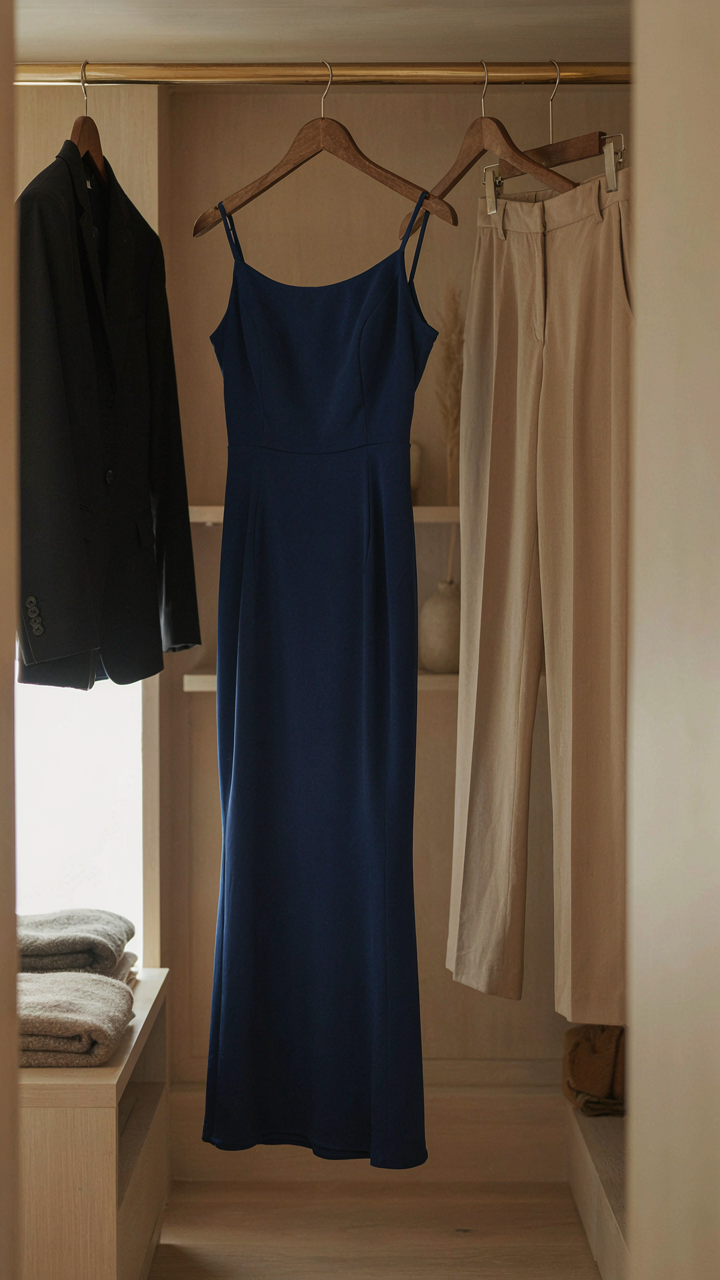
- Jewel-tone midi dress: Deep emerald, sapphire, or burgundy works at holiday parties, winter weddings, and office events. The length and richness read formal without screaming seasonal.
- Black tailored blazer: Pairs with dress pants for work, over a cocktail dress for parties, worn open over a sweater casually. This is the highest-utility piece in professional wardrobes.
- Neutral slip dress: Cream, black, or charcoal in silk or crepe layers under blazers, sweaters, and cardigans. Moves from office to evening without alteration.
- Wide-leg trousers in neutral: Navy, black, or grey tailored trousers transition from daily wear to holiday events when paired with different tops. Foundation piece, not decoration.
- Statement earrings in metal or pearl: Add visual weight to simple outfits without requiring seasonal themes. Works year-round across multiple occasions and dress codes.

The math is simple: a fifty-dollar piece worn five times costs ten dollars per wear. A hundred-dollar piece worn fifteen times costs six dollars per wear. Buy pieces that move between contexts, not pieces tied to a single event.
Fabric And Construction That Survive Repeated Wear
Most advice says buy quality and leave it at that. That’s incomplete. Quality without proper care protocol fails. Natural fibers like wool and silk hold their structure longer than synthetics under repeated stress, but construction matters equally. Seam strength, hem technique, and lining quality determine whether a dress becomes unwearable after three seasons or lasts a decade.
When you evaluate a piece for the office party, inspect the seams for reinforcement stitching, check that linings are sewn at stress points rather than glued, and verify that hemlines use a proper lockstitch or whip stitch rather than a single-line stitch. These details cost manufacturers slightly more but add years to garment life. Store pieces correctly between events: hang dresses on padded hangers, fold heavy knits, use cedar or sealed containers for seasonal storage. This single protocol prevents the slow decay that makes clothes unwearable.
The Post Party Dress Review: Christmas Party Dress Ideas Feedback Loop

What Actually Happened In The Room
You want to know if people noticed you, which means you’re afraid they didn’t, which means you wore something safe. The real mechanism here is feedback lag: you get social signals in real time but misinterpret them because you’re anxious, then you overwrite your own judgment with invented narratives. Document what actually occurred instead of what you felt.

Write down three specific moments: who complimented the outfit, what they said exactly, and the context. Did colleagues engage differently with you? Did you feel restricted by the dress or confident? Note the practical details too: did the fabric wrinkle, did the neckline shift, did you need to adjust anything repeatedly? These observations beat vague impressions.
Calibrating Your Next Move
Common advice says “wear what makes you feel confident,” which is worthless because feelings shift hourly. Instead, treat this like A/B testing in marketing: you collect data points, identify what worked mechanically, and replicate it. Your office party outfit was a variable. Extract what changed about how people treated you or how you moved through the room.
If you wore a structured blazer and people took you seriously in conversation, that’s a data point. If you wore a dress and spent the night tugging at the hem, that’s friction you eliminate next time. Build a simple rule: what silhouette, color, and material made you functional? Make that your baseline for similar events. Skip the emotion, run the next iteration.
The Only Real Dress Code Is Your Ambition

Stop treating your office Christmas party outfit like a permission slip. The dress you choose either signals you’re playing it safe or you’re playing to win. Pick something that makes you walk differently. That confidence shift is what people remember, not the fabric. Wear the dress that scares you a little. The one you’ll actually own instead of apologize for.