
Beyond “Formal”: Deconstructing The Dress Code Delusion

Where The Invitation Really Comes From
You’re worried about looking wrong because you’re afraid of signaling low status in front of people you’ll never see again. The mechanism nobody states plainly: dress codes aren’t rules handed down from etiquette gods. They’re signals of the host’s social circle and geography. A black-tie wedding in Manhattan reads differently than one in Nashville. The same outfit performs different work in different rooms. Your job is to decode which room you’re actually in, not memorize some universal formal standard that doesn’t exist.
Regional conventions shape what “formal” means before the invitation arrives. East Coast events lean toward stricter tailoring and darker palettes. West Coast affairs allow more color and fabric variation. Southern celebrations often embrace bold patterns and lighter tones. Midwest weddings tend toward conservative classics. The invitation’s language matters less than understanding where the wedding happens and who throws it. A fashion industry founder’s black-tie wedding operates on different rules than a lawyer’s. Hunt down context before picking fabric.
The Signals Hidden In Plain Language
The common advice here is trash. Most people think “black-tie optional” means you can wear whatever feels comfortable. It doesn’t. Using information theory, “optional” in dress codes functions like a signal with noise: the base message is black-tie formality, but the sender is reducing social penalty for non-compliance. You still need formal wear. You just won’t get judged if you skip the tuxedo. “Cocktail attire” means tailored pieces that work at a bar, not casual clothes dressed up with heels. “Formal” means structured silhouettes, quality fabric, zero wrinkles.
Read the invitation’s other details to calibrate. If the ceremony starts at 6 PM and the reception follows immediately, expect traditional formal wear. If the invitation specifies a color palette or theme, the host is signaling flexibility within that constraint. If it mentions the venue’s name, research the space. A museum event demands different polish than a garden venue. Check whether the host lists a dress code at all. Absence of one doesn’t mean casual. It means the host assumes you know the baseline for that time and location.
The 3 Tier Attire Decryption Protocol For Formal Wedding Attire Women Guest
What The Dress Code Actually Signals
You’re worried you’ll show up wrong and get silently judged. That fear is the only reason this matters. Here’s the mechanism: dress codes exist because the couple needs you to visually confirm their event’s social weight. Black tie means something different than cocktail attire because they’re signaling different things about their resources, formality tolerance, and guest expectations. The code isn’t arbitrary—it’s a filter.

Most advice stops at defining the terms and calls it done. That’s incomplete. What matters is understanding the hierarchy: black tie demands floor-length gowns or jumpsuits with structured formality. Formal attire accepts midi or knee-length dresses with less rigidity. Cocktail allows shorter lengths and creative silhouettes. Semi-formal gives you room to experiment while staying polished. Each tier has a specific constraint that determines your neckline, sleeve presence, and shoe formality. You read the invitation’s exact phrasing, not the vibe you feel.
How Venue Architecture Determines Your Options
The building itself dictates what works. Think of it like a structural load bearing requirement from engineering: the venue’s design capacity determines what outfit will function. A rooftop venue in summer demands different cooling and lightness than a winter ballroom. An outdoor garden reception at dusk requires fabric that photographs well in low light and shoes that won’t sink into grass. An indoor urban hotel with hard flooring allows heels that would be impractical elsewhere.
The real decision tree starts with venue logistics, not personal preference. If the ceremony runs late into evening outdoors, you need a wrap or structured jacket—not optional. If it’s indoors with heavy air conditioning, bare shoulders create temperature problems for you. If the space has uneven terrain or gravel, metallic or delicate footwear fails immediately. Scout the location’s actual layout before finalizing fabric weight, heel height, or neckline exposure. The venue constrains your choices more than the dress code does.
Navigating Seasonal Nuance: Wedding Guest Outfit October
The Fabric Question For Autumn Evening Wear
You want to look polished without overheating or freezing, and you’re betting fabric choice handles that problem silently so nobody watches you adjust layers all night. It doesn’t. Fabric is a heat-management system, and October requires materials that trap warmth without trapping moisture. Wool blends, silk charmeuse, and structured cotton hold their shape in cold air and prevent the limp collapse that happens with lightweight summer fabrics. Avoid raw linen for evening events in October. It wears thin and reads casual in autumn’s harder light.

The mechanism is fiber density and thread construction. Tightly woven materials create dead air pockets that insulate without bulk. A 65/35 wool-silk blend outperforms 100 percent silk because the wool fibers hold stable in temperature swings while silk alone slides around and loses its drape as your body temperature fluctuates. Check weight on fabric tags. Aim for pieces labeled medium to heavy weight. This prevents the silhouette collapse that kills formality faster than the wrong color.
Strategic Layering For Temperature Shifts
Most advice says “layer up” then abandons you with no actual framework. Temperature management uses insulation principles. Your base layer captures moisture, your middle layer traps heat, and your outer layer blocks wind. An October evening reception hits 55-65 degrees Fahrenheit depending on venue and time. You need pieces designed to come on and off without disrupting your silhouette or forcing you into awkward adjustments mid-ceremony.
Wear a structured shawl, silk-lined blazer, or cropped jacket as your removable piece. Choose something that sits above the hip so it doesn’t interfere with your dress or pants when you take it off. Keep it in the coat check immediately after dinner ends. A thin turtleneck under a dress adds warmth without visible bulk. Wear it, own it, forget about temperature management for the rest of the night.
Formal Dresses For Weddings: Material, Cut, And Covert Comfort

Weight Over Flash
You want to feel expensive without looking like you tried too hard. That’s the real calculation here, and fabric weight is the mechanism that does it.

Heavier fabrics signal quality because they cost more to produce and move differently on your body. Silk charmeuse, wool crepe, and structured cotton blends drape with intention. They don’t cling or shift during the ceremony. Light fabrics like chiffon and jersey move too freely, reading as budget even when they aren’t. The weight creates a visual “pause” that makes people register the garment as intentional. Touch matters less than how the material behaves under light and motion across several hours.
Evening light is unforgiving. Thin fabrics show every shift in your posture and body. Heavy fabrics absorb and redistribute that light, creating definition and presence. A 100% silk crepe dress at evening weighs enough to stay put, resisting wrinkles from sitting through ceremony and dinner. Polyester blends marketed as “silk-like” fail here because they lack the density. Buy the heavier option. It performs.
Silhouette As The Unspoken Signal
In fashion semiotics, silhouette is the language your body speaks before anyone hears your voice. A-line reads traditional. Fitted reads confident. Loose reads either effortless or indifferent, depending on execution. Evening weddings demand clarity in what you’re signaling.
Fitted silhouettes at evening events work because they require your body to earn the line. They demand good posture and deliberate movement. Loose silhouettes work only if they’re cut with structure, not draped without intention. A shapeless dress at night looks like you grabbed the first thing. The cut determines whether people see refinement or apathy. Column dresses, wrap dresses with defined waists, and A-lines with fitted bodices all read as “I considered this.” Tent dresses and oversized fits at formal evening events create distance between you and the event.
Choose a silhouette that fits your actual frame, not one you think should fit you. Your dress either works with your proportions or creates visual noise that reads as discomfort. The silhouette you wear is the shape people remember.

The Power Play Of The Women Suit For Wedding
Tailoring For Authority And Comfort
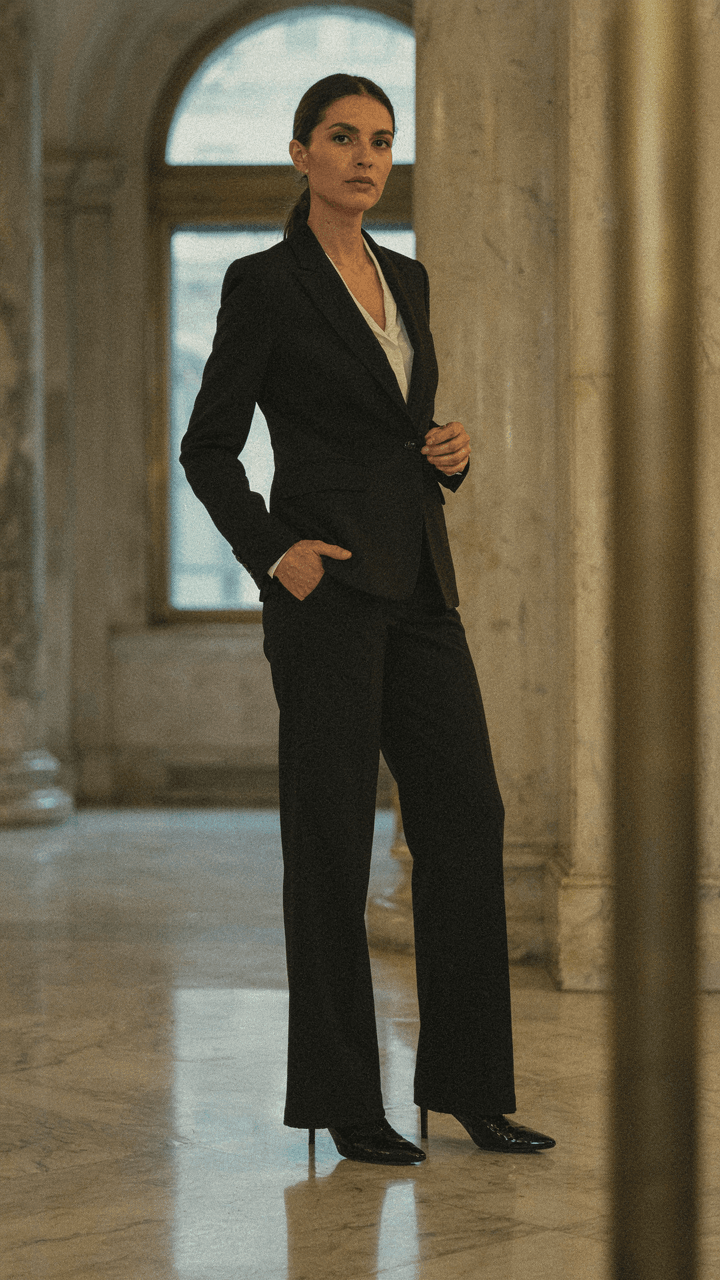
You want people to take you seriously without trying. That’s the real reason you’re considering a suit. The mechanism is simple: a suit signals you’ve made a deliberate choice, not defaulted to a dress. Tailoring transforms that signal into fact. An ill-fitted suit reads as borrowed or uncertain. A tailored suit reads as intentional. The difference between the two determines whether you project control or anxiety in a room full of strangers watching you arrive.
Tailoring starts with fit at three points: shoulders, chest, and waist. A tailor adjusts jacket length to hit at your hip bone, sleeve length to your wrist bone, and pants to break slightly on your shoe. This isn’t cosmetic. Proper proportions create visual weight distribution that makes you move differently through space. You stand straighter. You take up less nervous energy thinking about how you look. That freed attention becomes presence, which reads as confidence to anyone watching.
Accessory Choices For Suit Refinement
Generic advice says add jewelry to soften the look. Skip that. A suit already reads formal. Adding more objects clutters the signal. Instead, treat accessories as subtraction. A single piece that echoes the suit’s formality amplifies rather than distracts. A structured clutch in matching or neutral tone, a watch with clean lines, minimal earrings if any. Each piece should have zero visual noise. Patterned scarves, chunky bracelets, multiple rings all create competing focal points and undermine the suit’s authority.
The shoe choice determines how grounded the look feels. A pointed-toe heel elongates the line and maintains the suit’s formal register. A flat or minimal heel shifts the energy toward approachable rather than intimidating. Neither choice is wrong. The mechanism is alignment: choose based on the room’s formality and your actual comfort in the shoe for a full evening. If you’re conscious of foot pain, your posture collapses. Collapse reads as uncertainty. Select shoes you can stand in for four hours without thinking about them.

Elegant Evening Outfits For Women: Feedback Loops Of Perception
Your Outfit As A Control System
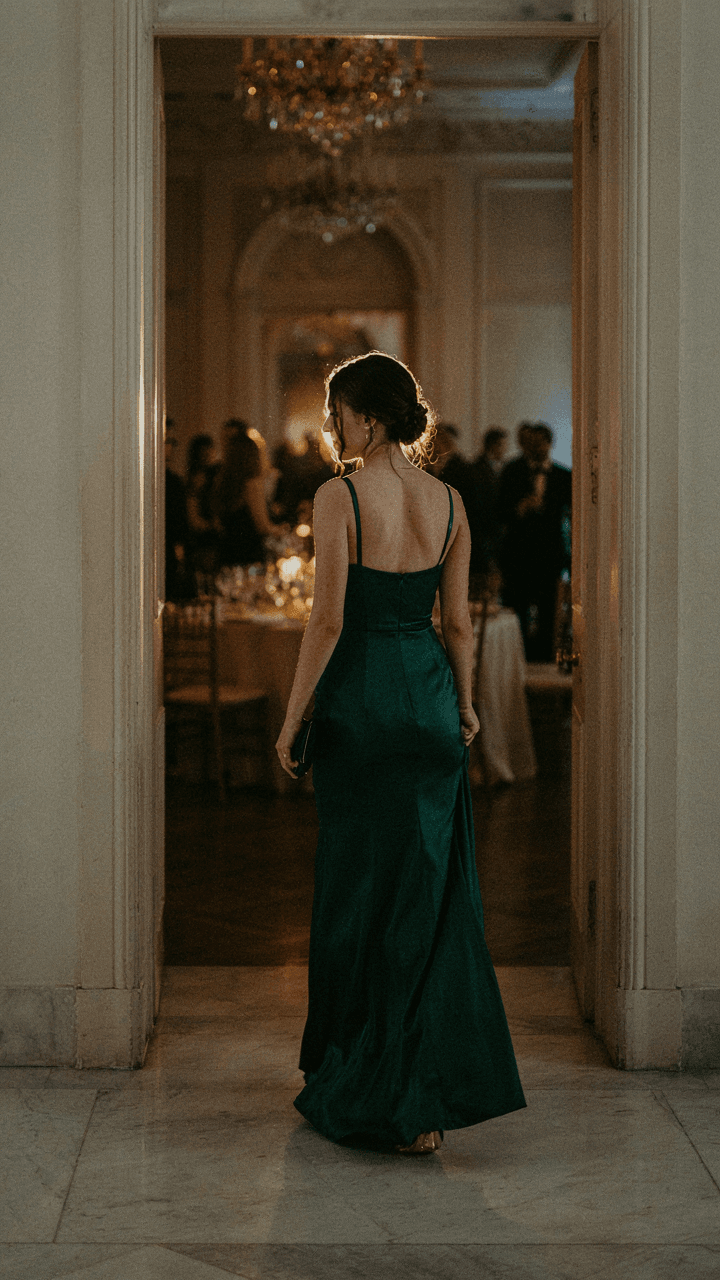
You care about this because you’re afraid people will misjudge you in the dark. Cybernetics teaches us that systems maintain desired states through feedback loops, and your evening wedding outfit works the same way. The mechanism isn’t about looking good in absolute terms. It’s about sending input signals that trigger predictable outputs in how others perceive your status, effort, and social placement. The outfit adjusts the room’s feedback about who you are before you speak.
Evening lighting removes the safety net of daylight detail. Shadows flatten fabric texture, mute color complexity, and force contrast to do the heavy lifting. This constraint actually clarifies what controls perception at night. Silhouette dominance, fabric sheen, and jewel tone saturation become your control variables. You manipulate these three inputs to stabilize the output: recognition that you belong at this event and took the occasion seriously. The system requires precision because errors compound in low light.
Signal Clarity Over Decoration
Most advice tells you to add jewelry, add shine, add drama. That’s incomplete. In evening conditions, more inputs don’t mean clearer signals. They create noise. A dark midi dress with one bold neckline communicates formality faster than a black dress layered with five accessories fighting for attention. The real mechanism is signal-to-noise ratio. High contrast between you and the background, intentional focal points, and cohesive color restriction send unmistakable information. Your brain decodes the outfit in two seconds in dim light, and competing visual elements slow that decoding down.
Commit to one statement per outfit. Either your neckline commands attention, or your shoes do, or your fabric has luminous properties. Not all three. A satin back or draped detail creates visual weight without requiring additional objects. The fabric’s interaction with light becomes your secondary signal, layered under the primary one. When you walk into the reception space, you want guests to process your outfit as coherent and intentional within that single second of initial assessment, before any detail work registers.
The Evening Blazer: Strategic Utility Beyond Warmth

How A Blazer Transforms An Outfit
You want the blazer because you’re afraid of looking incomplete. The real mechanism is proportional authority. A blazer anchors an outfit by creating visual weight at the shoulders and defining the torso’s silhouette. Without it, evening wear reads as fragmented. With it, separated pieces cohere into a unified statement. This is why a blazer works on nearly every body type and fabric combination. It’s not decoration. It’s structural.
Evening blazers function differently than daywear equivalents because they operate in low light and formal context. The fabric matters more here. Silk blends, wool, and cotton mixes reflect light strategically. A matte black blazer reads as intentional authority. A charcoal one suggests sophistication without trying too hard. The cut determines whether you look ready for work or ready for celebration. Slim, tapered cuts work for formal evening wear. Oversized cuts demand high-confidence styling and specific body positioning to avoid appearing borrowed.
The Blazer As Visual Anchoring Point
Most advice treats the blazer as a warmth solution. That misses the real function entirely. The blazer is a visual anchor that makes everything underneath it appear deliberate. Graphic tees, simple dresses, separates that might seem plain on their own suddenly read as styled and intentional the moment a blazer covers the top half. This is proportion leverage in fashion. You’re using one strategic element to elevate three or four pieces simultaneously.
A blazer works best when the fit at the shoulders matches your actual shoulder width. Shoulders too wide swallow the frame. Shoulders too narrow create visual imbalance that no tailoring fully corrects. Sleeve length matters more than most people realize. Sleeves should hit at your wrist bone or a half inch above it. Button placement should align with your natural waist. These aren’t style preferences. They’re structural requirements that determine whether the blazer functions as an anchor or creates visual chaos.

Cocktail Suits Women: Navigating The Semi Formal Divide
Where Cocktail Stops And Black Tie Starts
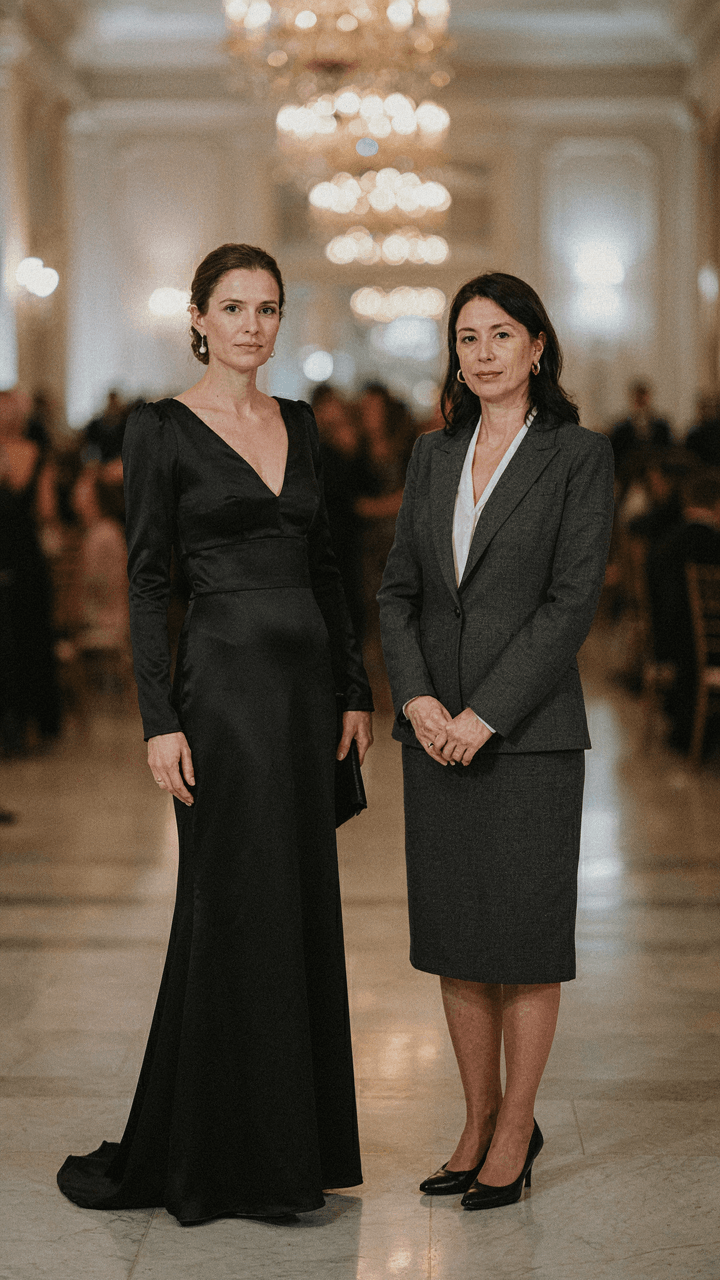
You’re anxious about being overdressed or underdressed, which means you’re worried about signaling the wrong status to people who won’t remember what you wore anyway. The real mechanism is this: cocktail and black tie differ by one rule about fabric weight and one rule about skin coverage. Cocktail allows structured suiting in wool blends. Black tie demands silk or satin with specific neckline requirements. The invitation wording matters less than the venue type. An evening wedding at a country club signals black tie. The same time slot at a restaurant signals cocktail. Check what the bride wore to her engagement party or bridal shower. That’s your actual anchor point, not the invitation card.
The common advice lumps them together. Don’t do that. Cocktail suits for women are separates or single pieces that read formal but leave room for interpretation in hem length and sleeve treatment. Black tie suits demand floor-length skirts, sleeveless or cap-sleeve construction, and metal hardware that catches light. A cocktail suit works at an evening wedding when the invitation explicitly says cocktail or when you see other guests in knee-length dresses. If you show up in a cocktail suit to a black tie event, you signal either ignorance or indifference. Both hurt.
The Fabric And Detail Code
These two categories live in different material ecosystems. Cocktail fabrics are working fabrics: structured wool, crepe blends, linen mixtures, and cotton sateen. Black tie demands lustrous fabrics that absorb and redirect light. Silk charmeuse, silk mikado, and wool gabardine with satin panels are the standard markers. Embellishment tells the same story. Cocktail allows beading, sequins, and embroidery as accent details. Black tie reserves embellishment for structured placement: a beaded shoulder, a sequined waistband, or a metallic trim on a hem. Scattered or all-over embellishment reads cocktail, not black tie.
- Wool Crepe Suiting: Holds structure without shine. Works for cocktail separates or single-piece suits. Accepts darts and seaming without distortion.
- Silk Charmeuse: Liquid movement with inherent formality. Required for black tie floor-length skirts. Reflects light at movement points.
- Satin Piecing On Wool: Hybrid approach that bridges codes. Satin panel on the side of a wool skirt reads formal without full black tie commitment.
- Embroidered Accents: Beading on the shoulder or hip reads cocktail. All-over beading reads evening formal or resort wear, not evening wedding guest.
- Metallic Threading And Trim: Gold or silver thread woven into fabric signals formality level. Use restraint for cocktail, strategic placement for black tie.
The distinction is tactile first, visual second. Touch the fabric before buying. If it drapes like water, it’s black tie material. If it holds its shape and has slight resistance, it’s cocktail. Your fitting process should confirm this: cocktail suits should fit cleanly at the hip and waist with minimal alteration needed. Black tie suits require a tailor because the fabric demands precision. Do not buy a cocktail suit expecting to wear it to a black tie event by adding heels and jewelry. The fiber itself will betray you.

Wedding Guest Outfit Elegant: The Art Of Understated Command

Don’t Compete With The Couple
You’re worried people will judge you for not looking expensive enough. Here’s the mechanism: the moment you try to outshine everyone else, you signal insecurity, which reads louder than any outfit detail. Elegance in evening wear operates on a principle borrowed from military strategy called “economy of force.” You deploy resources only where they matter. Overloading your outfit with competing elements, bold colors, or statement pieces dilutes impact instead of amplifying it. Restraint is the actual power move.
The guests who command a room wear fewer things, chosen with absolute precision. A tailored black suit, a structured column dress, or a clean silhouette in navy reads as controlled and intentional. The person wearing six trends at once looks reactive. You’re not there to be the most memorable person. You’re there to belong while standing apart through discipline, not noise. That distinction changes how you move through the evening.
The Precision Of Neutral Tones
What most wedding advice misses is that neutral colors aren’t boring—they’re a technical choice. Dark tones (charcoal, black, navy, deep burgundy) and warm neutrals (taupe, champagne, soft gray) work because they don’t fight the lighting at evening receptions. Candles, uplighting, and dim ambient light flatten bright colors and make them look washed out or garish. Your outfit becomes a canvas for light to work with instead of against. The fabric itself becomes the visual interest.
This is where execution separates the obvious from the sophisticated. Invest in natural fiber quality over logo visibility. Silk, wool crepe, fine linen, and cotton blends hold their shape under evening light and move with intention. A navy dress in quality silk reads like precision. The same dress in polyester looks like a costume. Texture and drape communicate wealth and respect faster than any label. Choose one elevated fabric piece as your anchor, then let everything else support it without competing.
The True Faux Pas Is Believing Style Excuses Ignorance
Most people treat evening wedding guest outfits like a problem to survive instead of a chance to communicate something about themselves. They hide behind “I don’t know what to wear” when they actually mean “I didn’t care enough to decide.” The dress code exists. You have access to every outfit idea ever created. You either show up intentional or you show up invisible. Pick one before you walk through that door.